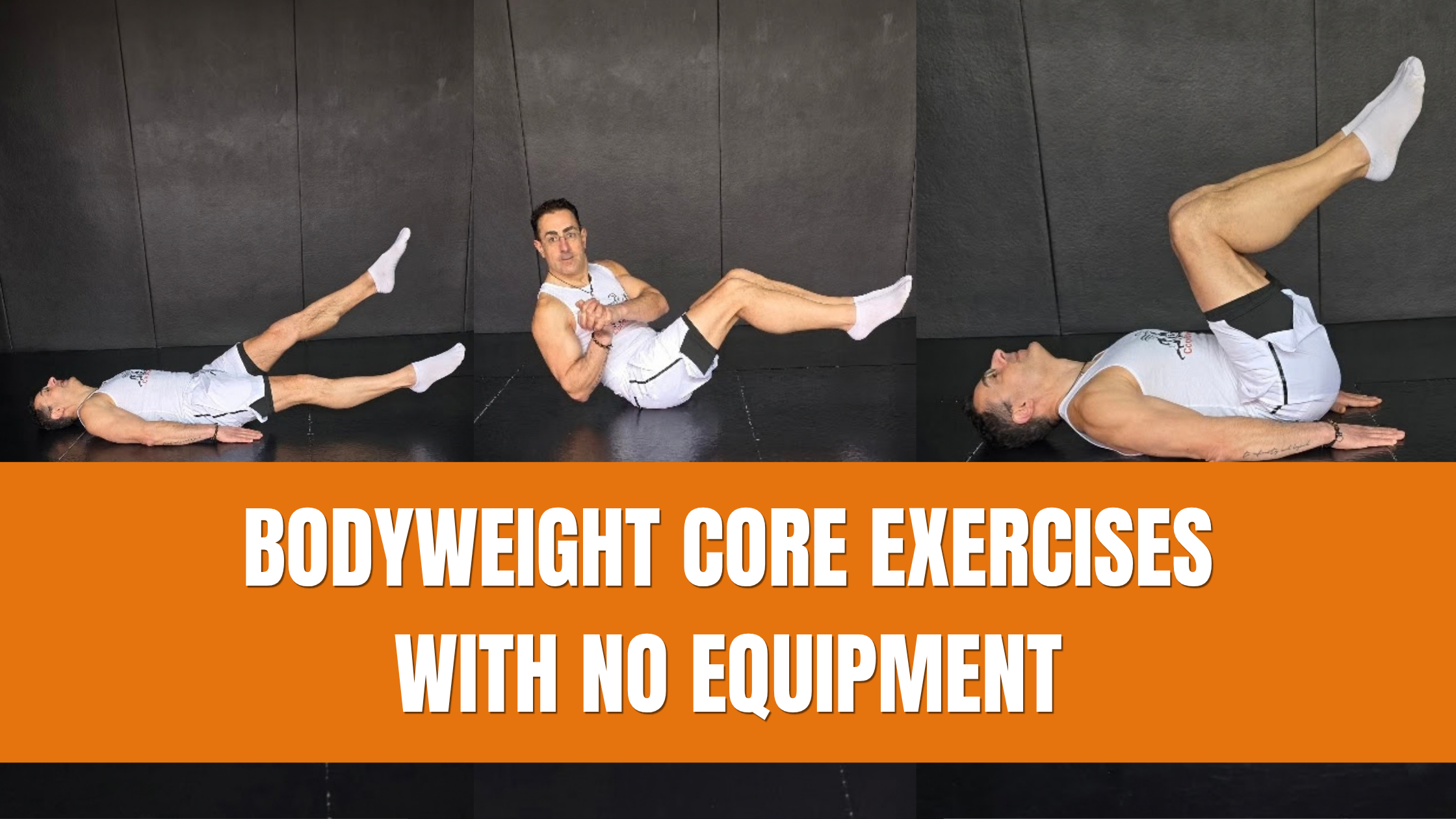
What are the best bodyweight core exercises?
The best bodyweight core exercises for calisthenics are the plank, dead bug, hollow body hold, side plank and single-leg glute bridge. Each builds core stability — the ability to keep a rigid trunk under load — rather than just isolating the abs. For calisthenics specifically, stability matters far more than the ability to do sit-ups.
This post is part of the calisthenics for beginners cluster. Every push and pull skill in calisthenics depends on a stable core, so the exercises below sit at the centre of your training — not as an afterthought at the end of a session.
Why calisthenics needs a different kind of core work
Most people associate core training with crunches and sit-ups. In calisthenics, those movements are largely irrelevant. What you need is anti-extension (resisting a bent spine under load), anti-rotation (resisting a twist) and anti-lateral flexion (resisting a side bend).
When you do a push-up, your core must hold your trunk rigid so force transfers from your hands through your hips to the floor. When you do a pull-up, your core stops your legs from swinging. Neither movement requires you to crunch. Both require you to brace.
The five exercises below train exactly those demands.
The five exercises
1. Plank
What it trains: Anti-extension. Resisting the spine from caving toward the floor.
How to do it: Forearms flat on the floor, elbows directly under shoulders. Feet together or hip-width apart. Push the floor away with your forearms — do not just hold. Keep a straight line from heels to head. Brace your abs as if bracing for a punch. Do not hold your breath.
Progression Table:
| Stage | Target | Notes |
|---|---|---|
| 1 | 3 x 20 seconds | Short, solid holds are better than long shaky ones |
| 2 | 3 x 30 seconds | Add time only when form is solid |
| 3 | 3 x 45 seconds | Most beginners are ready for harder variations here |
| 4 | Plank with shoulder tap | Tap opposite hand to shoulder without hip rotation |
Common mistake: Letting the hips rise or drop. Both cancel the anti-extension demand.
2. Dead bug
What it trains: Anti-extension and anti-rotation simultaneously. One of the most useful core exercises in calisthenics.
How to do it: Lie on your back. Arms point toward the ceiling. Knees bent at 90 degrees, shins parallel to the floor. Press your lower back into the floor and keep it there throughout. Lower one arm and the opposite leg toward the floor at the same time — slowly — without letting your back arch. Return. Repeat on the other side. Count each side as one rep
Progression Table:
| Stage | Target | Notes |
|---|---|---|
| 1 | 3 x 5 each side | Feet stay low but do not touch the floor |
| 2 | 3 x 8 each side | Add a 2-second pause at the bottom |
| 3 | 3 x 10 each side | Full extension: heel one inch from the floor |
| 4 | Add a resistance band | Loop around both hands, pull apart throughout |
Common mistake: Arching the lower back as the leg lowers. If this happens, reduce range of motion until you can keep your back flat.
3. Hollow body hold
What it trains: Full-body tension. The hollow body is the foundation position for push-ups, pull-ups, dips and handstands.
How to do it: Lie on your back. Press your lower back into the floor. Tuck your chin slightly. Lift your legs and shoulders off the floor. Arms reach back overhead. Hold the position. Every muscle should feel engaged — legs squeezed together, toes pointed, arms straight, abs braced.
Progression Table:
| Stage | Target | Notes |
|---|---|---|
| 1 | Arms by side, knees tucked | 3 x 15 seconds |
| 2 | Arms overhead, knees tucked | 3 x 15 seconds |
| 3 | Arms overhead, legs at 45 degrees | 3 x 20 seconds |
| 4 | Full hollow: legs straight, low to floor | 3 x 20 seconds |
Common mistake: Letting the lower back come off the floor. Back stays pressed down at every stage.
4. Side plank
What it trains: Anti-lateral flexion. Resisting the spine from bending sideways.
How to do it: Forearm on the floor, elbow under shoulder. Stack your feet or stagger them (easier). Lift your hips until your body forms a straight diagonal line. Do not let your hip drop toward the floor or pike upward. Hold, then switch sides.
Progression Table:
| Stage | Target | Notes |
|---|---|---|
| 1 | 3 x 15 seconds each side | Knees bent if feet-stacked is too hard |
| 2 | 3 x 25 seconds each side | Full straight-leg hold |
| 3 | 3 x 30 seconds each side | Add a hip dip: lower hip to floor, lift back up |
| 4 | Copenhagen plank | Top foot on a bench, bottom leg off the floor |
Common mistake: Rolling the top shoulder forward. Keep your chest open and your top shoulder stacked directly above the bottom one.
5. Single-leg glute bridge
What it trains: Posterior chain strength and anti-rotation. Essential for squat and lunge progressions later in calisthenics.
How to do it: Lie on your back, knees bent, feet flat on the floor. Lift one foot off the floor, keeping the knee bent. Drive through the grounded heel, lift your hips until your body forms a straight line from knee to shoulder on the grounded side. Hold one second at the top. Lower with control. Complete all reps on one side before switching.
Progression Table:
| Stage | Target | Notes |
|---|---|---|
| 1 | 3 x 8 each side | Two-second hold at the top |
| 2 | 3 x 10 each side | Add a 3-second lowering phase |
| 3 | 3 x 12 each side | Keep a consistent height throughout |
| 4 | March at the top | At the top, lift the knee of the grounded leg briefly |
Common mistake: Hip dropping on the unsupported side. This signals weak hip abductors on the working side — reduce reps and focus on keeping the hips level.
How to fit these into your calisthenics sessions
Add two or three of these exercises at the start of each session, before your push or pull work. Core training works best when the muscles are fresh.
A simple rotation:
Session A: Plank + dead bug + single-leg glute bridge
Session B: Hollow body hold + side plank + dead bug
Session C: Plank + hollow body hold + single-leg glute bridge
If you are following the calisthenics workout plan for beginners, slot two core exercises before the main session on each of the three training days.
A note on breathing
Do not hold your breath during core exercises. Brace your abs by breathing out gently and contracting — as if you are about to sneeze — then maintain light tension through the movement while breathing normally. Full breath-holding raises blood pressure and reduces endurance unnecessarily.
When to add harder variations
Move to the next stage in each exercise when you can complete all sets with:
No form breakdown in the final rep
Normal breathing throughout
No compensations (hips dropping, back arching, shoulders shrugging)
There is no set number of weeks. Some people progress in two weeks. Others take four. Both are fine.
If you want structured coaching on technique and progression timing, the CoreFlow coaching programme includes regular form reviews and weekly plan adjustments.
FAQ
Can bodyweight core exercises replace weights for core training?
For beginners and intermediate calisthenics athletes, yes. The plank, hollow body hold and dead bug load the core through full ranges of motion without added resistance. They become challenging quickly when progressed correctly. Heavy barbell lifters may eventually need weighted core work, but for most people doing calisthenics, these bodyweight exercises are sufficient for years.
How often should I train my core?
Three times a week works for most beginners — one or two exercises per session as part of a full-body workout. Daily core training is fine for the lighter exercises like planks and dead bugs, but the hollow body hold and single-leg bridge are demanding enough to need a recovery day between sessions.
Is the hollow body hold essential for calisthenics?
Yes. The hollow body position is the foundation of almost every advanced calisthenics skill — handstands, levers, muscle-ups, ring work. Building it early, even in its tucked-knee version, pays dividends across every other skill you pursue.
What is anti-rotation and why does it matter?
Anti-rotation is the ability to resist your spine twisting under load. When you do a single-arm push-up, a cable row, or even carry a heavy bag on one side, your core must stop the body from rotating. The dead bug, side plank and single-leg bridge all train this quality. Most sit-up-focused programmes skip it entirely.
Do I need to feel a burn in my abs for the exercises to be working?
No. The burn feeling comes from metabolic fatigue in the rectus abdominis — the six-pack muscle. Most of the exercises here target the deeper muscles (transverse abdominis, multifidus, quadratus lumborum) that stabilise the spine. These fatigue differently. You will feel tension and effort, but not necessarily a burning sensation. Both are signs the exercise is working.
How long before I see results from bodyweight core training?
Strength changes happen within two to three weeks for beginners. Visible changes in muscle definition take longer and depend heavily on body composition, not just training. The functional improvements — better posture, less lower back fatigue, more control in push-ups — show up first.