
Beginner calisthenics comes down to four movement patterns: push, pull, squat and core. Learn the push-up, the table row, the bodyweight squat and the plank. Together they cover every major muscle group. Learn them in this order and train each one three times a week.
Eight exercise lists are easy to find. What beginners actually need is fewer moves, learned properly, with a clear step below and a clear step above each one. For the wider home plan these moves sit inside, read our beginner calisthenics home plan.
Why four moves and not eight
Your body has a small number of ways of moving under load. You push something away, you pull something towards you, you bend and straighten your legs, and you hold your trunk steady while the rest of you works.
Cover those four and nothing major is missed. Add more moves before the first four are solid and you spread your practice thin, so every move improves slowly.
| Pattern | Move to learn | Step below | Step above | Main muscles |
|---|---|---|---|---|
| Push | Push-up | Worktop push-up | Feet raised push-up | Chest, shoulders, triceps |
| Pull | Table row | Upright doorframe row | Pull-up | Back, biceps, rear shoulders |
| Squat | Bodyweight squat | Sit to a chair | Slow lowering squat | Quads, glutes, hips |
| Core | Plank | Knee plank | One foot lifted | Trunk, deep core, shoulders |
Move 1: the push-up
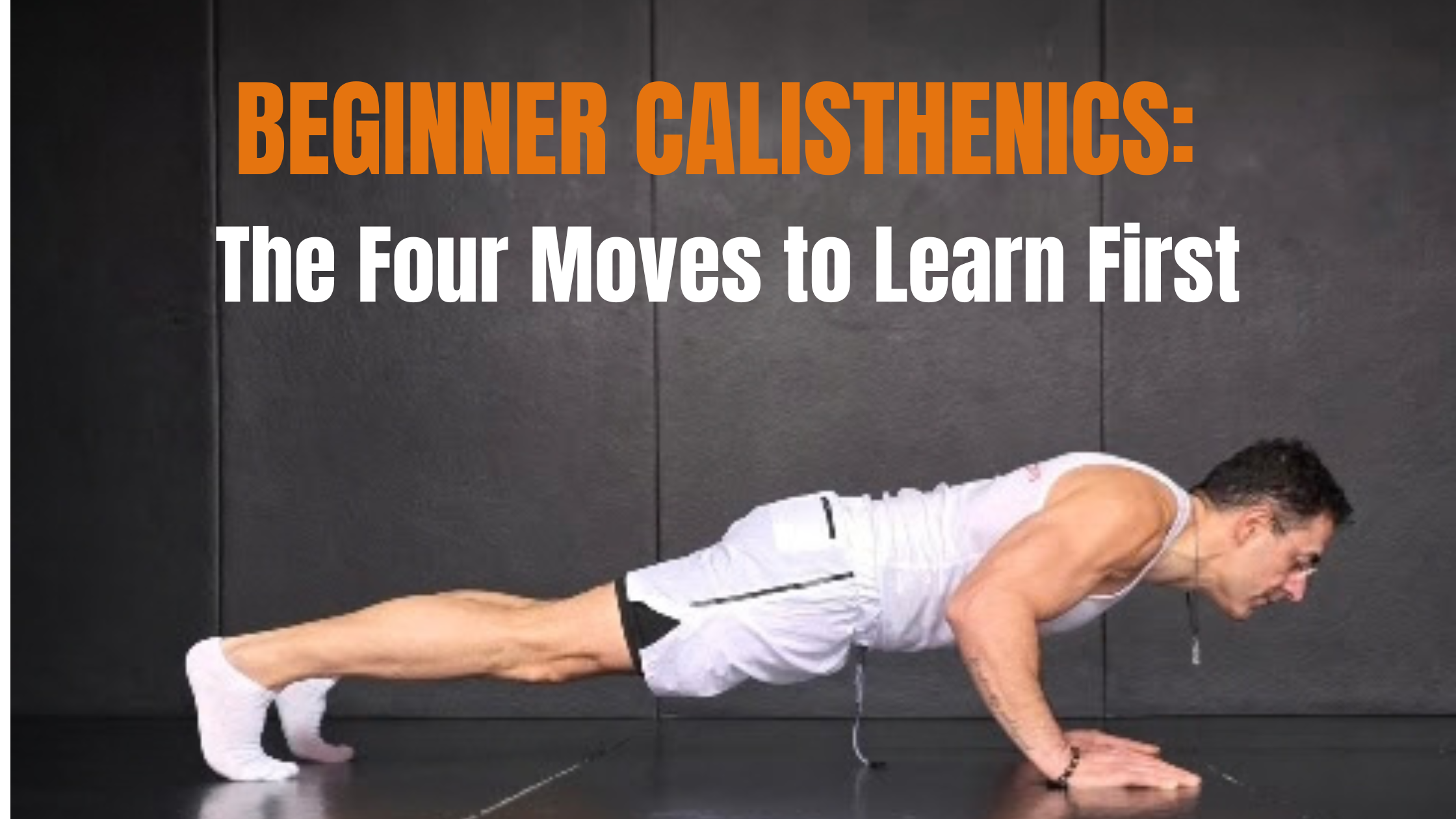
The push-up is the first move to learn because the shape it asks for carries into everything else. Hands under your shoulders, glutes squeezed, ribs tucked, one straight line from head to heels. Lower your chest, elbows tracking back at roughly 45 degrees, then press away from the floor.
Progression ladder: wall push-up, worktop push-up, knee push-up, floor push-up, feet raised push-up.
Move up a rung when you can do 12 clean reps for three sets twice in a row. Most beginners spend two to six weeks on each rung.
Move 2: the table row
Pulling is the pattern most home plans drop, because a pull-up bar is the obvious answer and few people own one. A sturdy dining table solves the problem. Lie underneath, grip the edge, keep your body straight and pull your chest towards the table.
Miss out pulling and your shoulders round forward over time, because your pushing muscles get all the work and your back gets none.
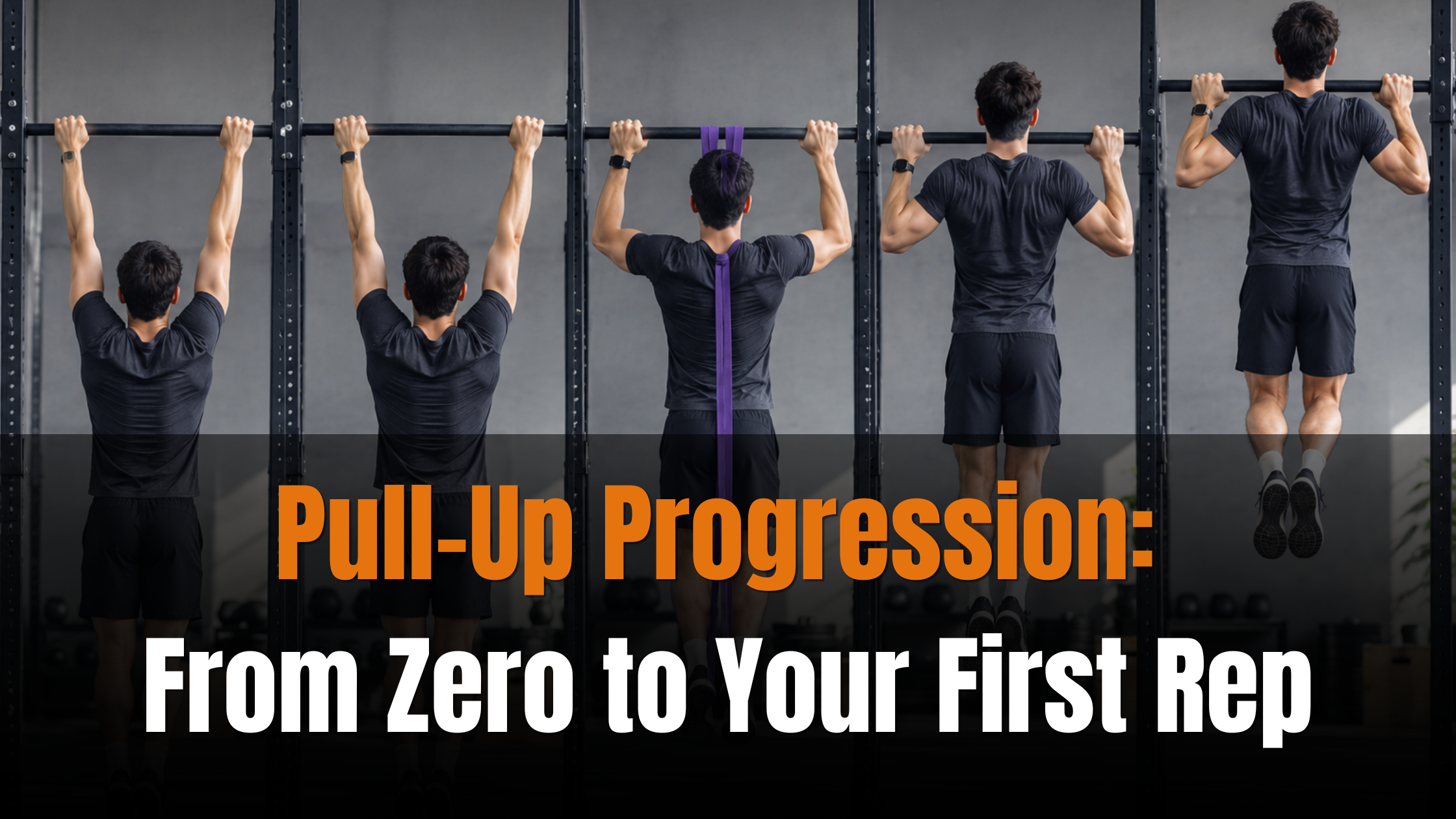
Progression ladder: upright doorframe row, table row with knees bent, table row with legs straight, pull-up with feet on the floor, full pull-up.
Check the table takes your weight before your first set.
Move 3: the bodyweight squat
The squat keeps your hips and knees working through a full range. Feet shoulder width, toes turned out slightly, hips back, knees bent, chest up. Lower until your thighs are near parallel with the floor, then drive up through your whole foot.
Depth comes from your hips and ankles, not from forcing it. If your heels lift or your back rounds, sit down to a chair instead and build depth over a few weeks. Tight ankles and hips respond to steady mobility work, so run some before each session.
Progression ladder: sit to a chair, chair tap, full squat, three second lowering squat, split squat.
Move 4: the plank
The plank teaches your trunk to brace under load, which the other three moves all borrow from. Forearms down, elbows under your shoulders, legs straight, glutes squeezed, hips level.
Breathe steadily through the hold rather than holding your breath, which is where our breathwork coaching helps. Time is not the measure here. The set ends when your hips drop or your lower back starts to arch, even if only 20 seconds have passed.
Progression ladder: knee plank, full plank, plank with one foot lifted, plank with a slow shoulder tap.
The order to learn them in
Learn one pattern at a time, but train all four from week one at whatever level you can hold.
- Week 1 and 2, push and core. Set your push-up height and your plank version. These two build the straight line shape.
- Week 3 and 4, squat. Set your depth and practise standing up without leaning forward.
- Week 5 onwards, pull. Add the table row once your shoulders are used to work.
Attention is the reason for the order. Spending two weeks thinking about one pattern beats spreading the same two weeks across four.
How to fit the four moves into a week
Three sessions a week, with a rest day between each. Every session covers all four moves: 3 sets of 8 to 12 reps on push, pull and squat, and 3 holds on the plank.
A session runs about 25 minutes including the warm-up. For the session written out with rest times and an easier version of each move, use our beginner calisthenics workout. If you are starting from no fitness at all, begin with how to start calisthenics instead. Prefer a shorter routine with no kit and no pulling move? Take the free calisthenics workout.
Common mistakes
- Skipping pull. The hardest pattern to set up at home, and the one people need most after years at a desk.
- Adding a fifth and sixth move early. More moves means less practice on each one.
- Judging a plank by the clock. Form ends the set, not the timer.
- Moving up a rung too soon. Twelve clean reps for three sets, twice in a row, then move.
- Training the same pattern two days running. Leave a day between sessions.
If you would rather have your rungs and rep targets set for you, look at our calisthenics coaching.
FAQ
What are the 5 basic calisthenics exercises?
Push-up, pull-up or row, squat, plank and lunge. The first four cover push, pull, squat and core. The lunge adds single leg work once the basics feel steady.
How should a beginner start calisthenics?
Pick the easiest version of four moves, train three times a week, and add one rep per session. Move to a harder version once you can do 12 clean reps for three sets.
How long should a beginner do calisthenics?
About 25 minutes per session, three times a week. Longer sessions add fatigue rather than strength in the first few months.
What is the 80 20 rule in calisthenics?
There is no official rule. Most coaches use the phrase to mean spending roughly 80 per cent of your training on basic moves and 20 per cent on skills, or stopping each set at around 80 per cent effort rather than going to failure.
Do I need a pull-up bar for beginner calisthenics?
No. A sturdy table or a doorframe covers pulling for the first few months. Add a bar when the table row with straight legs becomes easy.
How long until I can do a full push-up?
Most beginners get there in six to twelve weeks of training three times a week, working up the ladder from worktop to knee to floor.