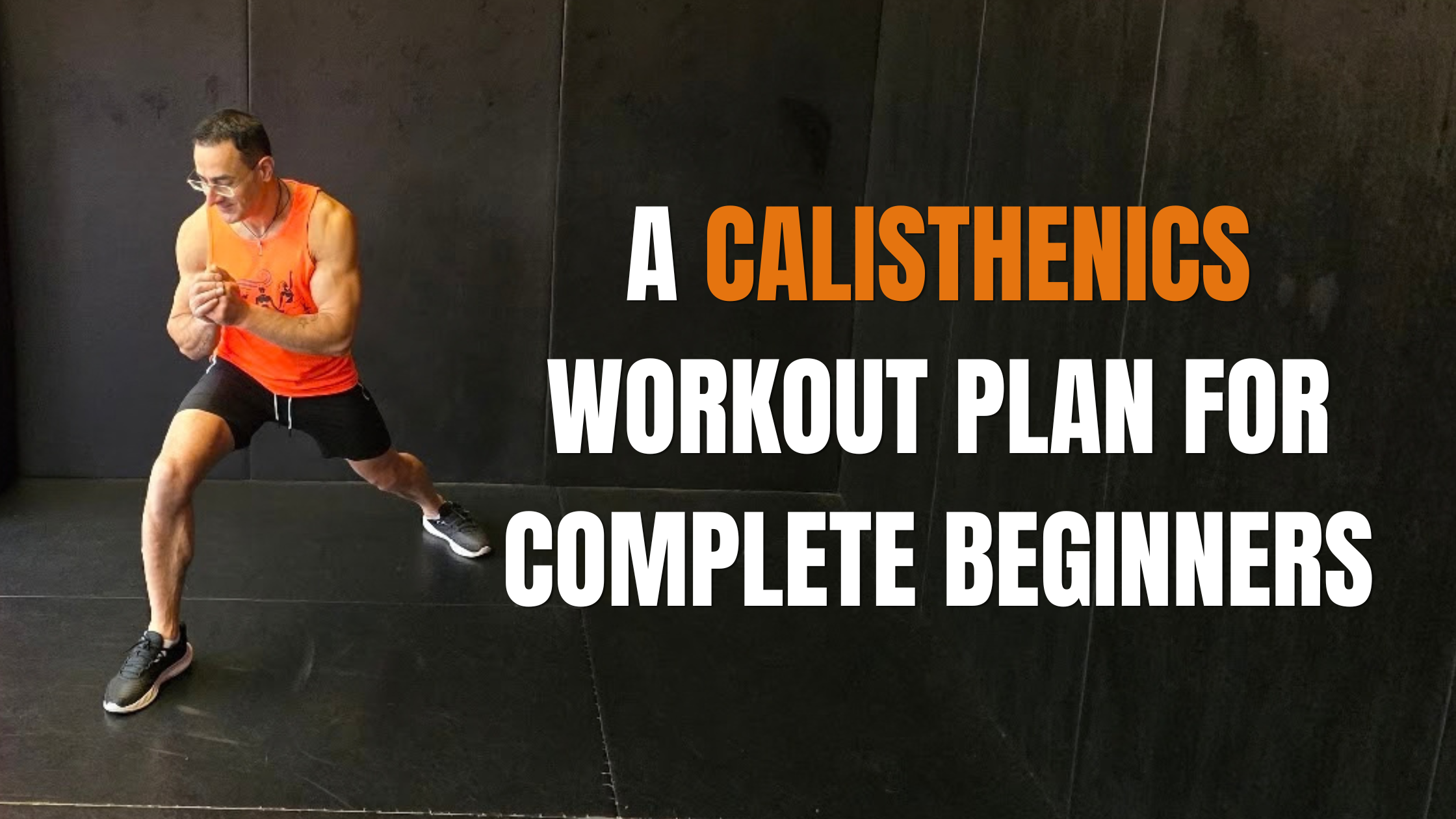


Start calisthenics with wall push-ups, chair squats, and short planks. Train three days a week for four weeks, rest a day between sessions, and add reps once each move feels easy. No gym or kit is needed. People in their 40s and 50s do well here, since every move scales down to protect the joints.
Most beginner guides skip two things: age and joints. This plan covers both, plus a simple four week structure you can follow at home.
What counts as calisthenics for a beginner?
Calisthenics for a beginner means simple bodyweight moves, done with control rather than speed. The core set is a push, a squat, a hinge, and a hold: wall or knee push-ups, chair squats, glute bridges, and short planks. Master these four before you add anything harder. Speed and fancy moves come later, once form is solid and confidence has grown.
Once this plan feels easy, our calisthenics coaching page covers the next steps and a full progression path.
Am I too old to start calisthenics at 40 or 50?
No. Muscle mass drops with age, so bodyweight training helps hold onto strength, balance, and bone density. Every move below has an easier version, so the plan meets your body where you stand today, not where a 20 year old stands. Many people in their 40s and 50s find calisthenics gentler on the joints than weights, since load stays at bodyweight and each rep can be scaled up or down.
How do I set up a joint friendly starting point?
Pick the easiest version of each move first, hold good form, and only add reps once a set feels comfortable.
Push-up: start against a wall, move to a countertop, then the floor.
Squat: hold a chair or worktop for balance until your legs feel strong.
Plank: drop to the knees before a full plank.
Pull work: skip in week one, add banded rows later once you have a door anchor or bar.
Sharp pain is a stop signal. General muscle tiredness the next day is normal and settles within a couple of days.
What is a simple four week beginner plan?
Train three days a week, with rest days between sessions. Add reps or move up a level once a set feels easy for two sessions in a row.
| Week | Main moves | Sets x reps |
| 1 | Wall push-up, chair squat, glute bridge, short plank | 2 x 8-10 |
| 2 | Same moves, add incline push-up on a low surface | 2 x 10-12 |
| 3 | Knee push-up, deep chair squat, plank held 20 seconds | 3 x 10-12 |
| 4 | Full push-up attempt, bodyweight squat, plank held 30 seconds | 3 x 12 |
How many days a week should a beginner train?
Three days a week, with a rest day between each session, gives muscles and joints time to recover while you still build a steady habit. Two consistent sessions a week beat five sessions done once then dropped.
Should mobility or breathwork sit alongside a calisthenics plan?
Yes. A short warm-up from our mobility work loosens hips and shoulders before you move, which lowers injury risk and makes each rep feel smoother. A few slow breaths from a short breathwork practice before or after training lower stress and help you show up for the next session. Pairing the three together is where real, lasting change happens, not from calisthenics alone.
What if a move causes pain rather than tired muscles?
Stop the move straight away, swap in the easier version, and check with a doctor if pain does not settle within a day or two. Never push through sharp or sudden pain to finish a set.
FAQ
Do I need a gym or equipment?
No. Every move in this plan works with your own body weight. A chair or wall gives extra support in week one.
Am I too old to start calisthenics at 40 or 50?
No. Bodyweight training scales to any starting point and helps protect strength, balance, and bone density as you age.
How many days a week should a beginner train?
Three days a week works well, with a rest day between sessions for recovery.
Is calisthenics safe for stiff joints?
Yes, when you pick the easier version of each move and build up slowly. Stop and check with a doctor if sharp pain shows up.
How long until results show?
Most beginners notice more strength and easier movement within three to four weeks of steady training.