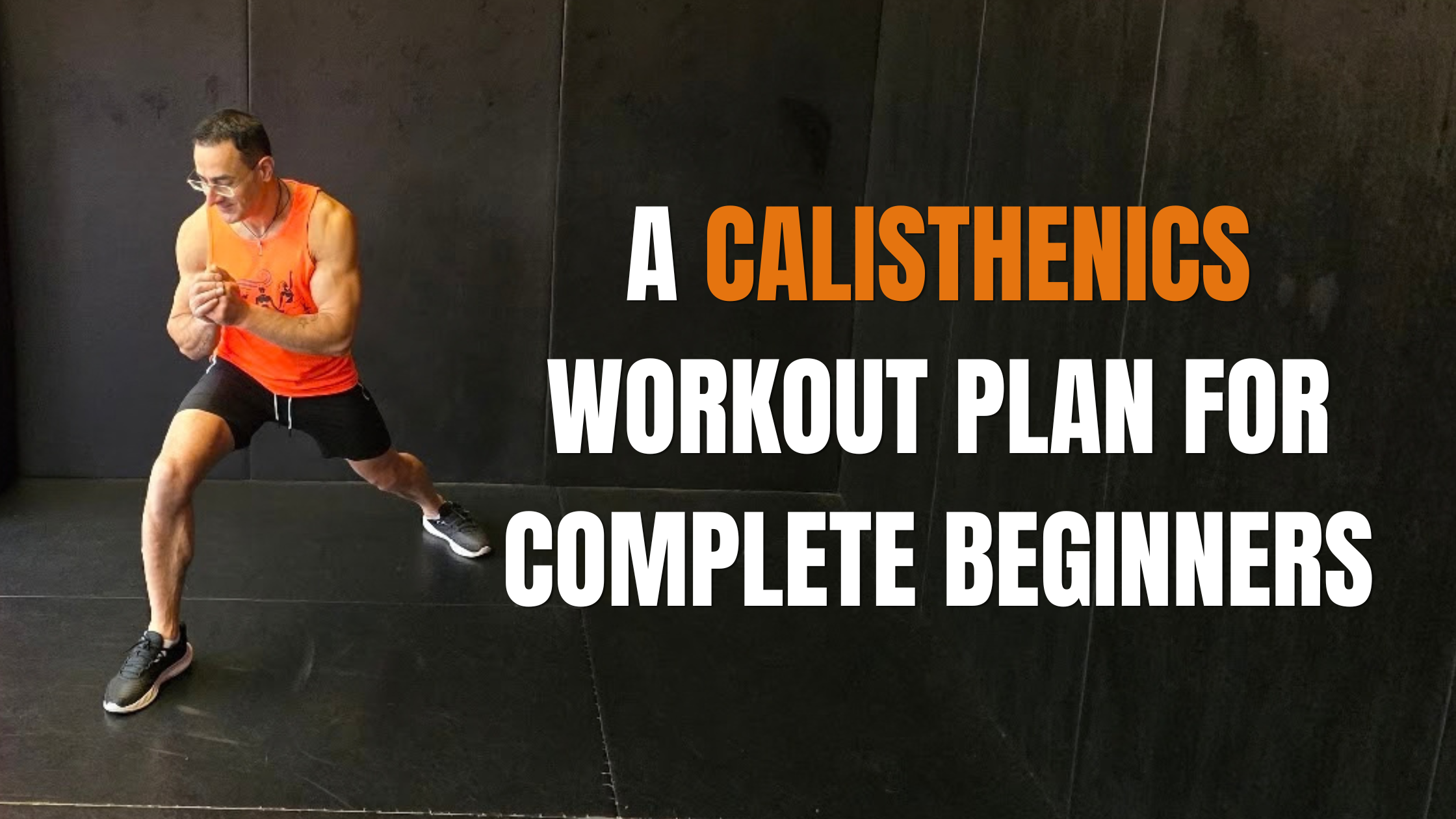

A beginner calisthenics workout uses five bodyweight moves: push-up, bodyweight squat, glute bridge, reverse lunge and plank. Do 3 sets of 8 to 12 reps per move, with 60 seconds rest between sets. Warm up for 5 minutes first. The whole session takes about 25 minutes and needs no equipment.
Most beginner routines online list moves and stop there. This one gives you the running order, the rest gaps, an easier version of every move, and the rule for adding load next week. For the wider picture on how bodyweight training works, read our guide to calisthenics for beginners.
The full workout at a glance
Run the moves in the order below. Finish all 3 sets of one move before starting the next.
| Order | Move | Sets | Reps | Rest | Easier version |
|---|---|---|---|---|---|
| 1 | Push-up | 3 | 8 to 12 | 60 sec | Hands on a worktop or wall |
| 2 | Bodyweight squat | 3 | 10 to 15 | 60 sec | Sit down to a chair and stand back up |
| 3 | Reverse lunge | 3 | 8 per leg | 60 sec | Hold a doorframe for balance |
| 4 | Glute bridge | 3 | 12 to 15 | 45 sec | Shorter range, stop halfway up |
| 5 | Plank | 3 | 20 to 40 sec | 45 sec | Knees on the floor |
Total working time is around 20 minutes. Add the warm-up and you finish in 25.
Warm up for five minutes
A five minute warm-up raises your heart rate and moves every joint you are about to load. Skip the warm-up and your first set feels stiff, which pushes people into poor form.
Do each of these for 45 seconds: marching on the spot, arm circles forwards then backwards, hip circles, slow bodyweight squats to a comfortable depth, and shoulder rolls. Breathe through your nose. Finish slightly warm, not out of breath. Stiff hips or shoulders respond well to a longer routine, so add some joint mobility work before your first set.
How to do each move
Push-up: The push-up builds your chest, shoulders and triceps, and teaches your core to hold a straight line. Set your hands under your shoulders, slightly wider than your ribs. Squeeze your glutes so your hips do not sag. Lower your chest towards the floor with elbows tracking back at roughly 45 degrees, then press up. If a floor push-up breaks your form, raise your hands. A kitchen worktop is a good starting height. Lower the surface as you get stronger. If even a worktop push-up is hard, follow our plan on how to start calisthenics, which begins at the wall.
Bodyweight squat: The squat trains your quads, glutes and hips through a range most desk workers lose. Stand with feet shoulder width apart, toes turned out slightly. Push your hips back, bend your knees and lower until your thighs are near parallel with the floor. Keep your heels down and your chest up. Drive up through your whole foot. If your balance wobbles, squat down to a dining chair, tap, then stand.
Reverse lunge: The reverse lunge builds single leg strength and steadies your hips, which matters more with every decade. Step one foot back, lower your back knee towards the floor, keep your front shin roughly upright, then push through your front heel to stand. Stepping back rather than forward puts less strain on the front knee, so most beginners find the reverse version kinder.
Glute bridge: The glute bridge wakes up muscles switched off by long hours of sitting, and takes pressure off your lower back. Lie on your back, knees bent, feet flat and close to your bottom. Press through your heels and lift your hips until your body forms a straight line from knees to shoulders. Squeeze for one second at the top, then lower slowly.
Plank: The plank teaches your trunk to brace, which every other move borrows from. Rest on your forearms with elbows under your shoulders. Extend your legs, tuck your ribs down, squeeze your glutes and hold a straight line from head to heels. Stop the set when your hips start to drop. A clean 20 seconds beats a sagging 60.
How often should you do the workout?
Do the full session three times a week with a rest day between each, for example Monday, Wednesday and Friday. Three sessions give your muscles enough work to adapt and enough time to recover. Beginners who train five or six days a week in week one usually stop by week three.
On rest days, walk for 20 to 30 minutes or run through the warm-up on its own. If you want the same session written as a weekly schedule, use our free calisthenics workout.
How to progress week by week
Add reps first, then sets, then difficulty. When you hit the top of the rep range on all three sets with clean form, move up one step:
Reach the top rep number on every set.
Hold there for one more session to prove the form.
Then either add a fourth set, or switch to a harder version of the move.
Harder versions in order: worktop push-up to knee push-up to floor push-up. Chair squat to full squat to slow three second lowering. Knee plank to full plank to plank with one foot lifted.
Common mistakes
Rushing the reps: Two seconds down, one second up. Speed hides weak spots.
Holding your breath: Breathe out on the effort, in on the way back.
Chasing soreness: Stiffness the next day is normal in the first fortnight. Pain in a joint is not.
Changing the plan every week: The same five moves for six weeks will do more than six different routines.
If you would rather have the reps and progressions set for you each week, look at our calisthenics coaching.
FAQ
How long should a beginner calisthenics workout be?
About 25 minutes, including a 5 minute warm-up. Three sessions a week is enough to build strength in the first two months.
Can I do calisthenics with no equipment at all?
Yes. All five moves in this workout use the floor and your own body weight. A worktop or sturdy chair helps for the easier versions.
Is a beginner calisthenics workout enough to build muscle?
Yes, for a beginner. Muscle grows when a movement is hard enough to challenge you for 8 to 12 reps. Once the moves feel easy, add reps, sets or a harder version.
How long before I see a change?
Most people feel stronger and steadier within three to four weeks. Visible changes usually follow after eight to twelve weeks of steady training and decent food.
Should I train if I am still sore?
Mild soreness is fine to train through. If a muscle is sharply sore or a joint aches, take an extra rest day.